
Pruning
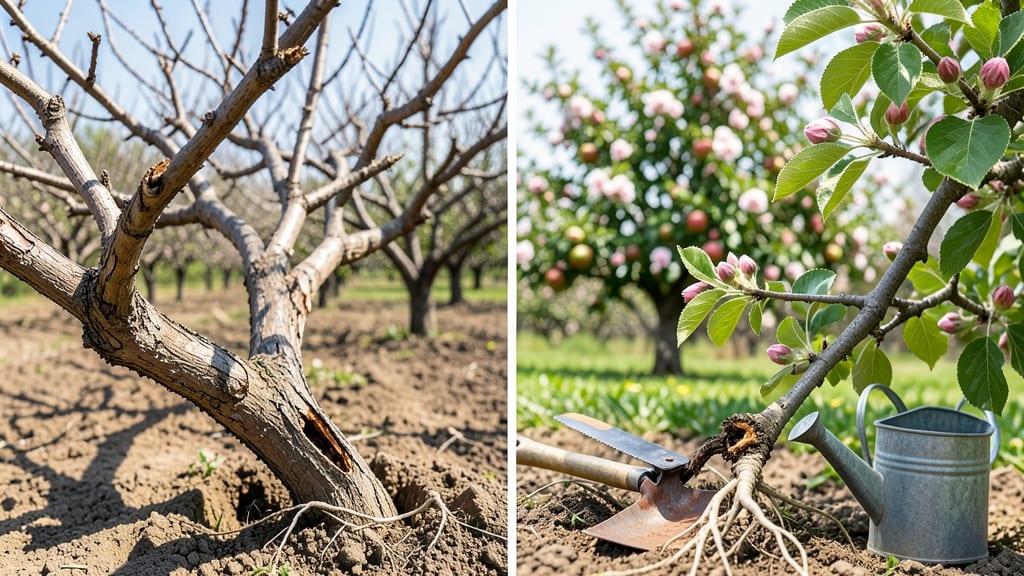
Determining if your apple tree is dead requires checking for dry branches that snap easily, peeling bark, and the absence of green growth or buds after spring. Always verify by looking for sap flow or fresh leaves, as some trees may appear lifeless but can recover with proper care.
Apple trees can be tricky to diagnose because they enter deep dormancy in winter, making it hard to tell if they're truly dead or just resting. 🌳 The key is to look beyond just the lack of leaves—healthy trees often show signs of life even in cold months, like moisture in the bark or small buds hidden under the surface.
I've seen many "dead" trees come back to life with consistent watering and proper pruning, so don't give up hope until you've ruled out dormancy.
What's interesting is how bark condition reveals a tree's health. If the bark peels away easily or shows dark, sunken spots, that's a red flag. But if you see fresh green growth or even a single leaf in spring, your tree might just need a little more time or attention.
For example, last year I had a client whose tree looked completely dead in winter, but when we checked for sap in the branches, we found it was still alive—just struggling with poor soil drainage.
💡 In This Article
- How to Diagnose a Dead Apple Tree vs Dormancy
- What to Do If Your Apple Tree Is Truly Dead
How to diagnose a dead apple tree vs dormancy
The key difference between a truly dead apple tree and one in dormancy lies in its biological response to seasonal changes. During dormancy, trees like Malus domestica (the scientific name for apple trees) undergo metabolic slowdown to conserve energy, which can make them appear lifeless.
However, healthy dormant trees still maintain moisture levels in their branches—you can test this by making a small cut in the bark and checking for sap flow. If the cut produces a clear or slightly milky liquid, your tree is likely alive but resting.
Bark condition is another critical indicator. Healthy bark should be firm and slightly rough to the touch, with a consistent color matching the tree's natural hue. When a tree dies, the bark often becomes brittle and peels away easily, revealing dark, sunken areas underneath.
For example, I once examined a 15-year-old Granny Smith that appeared dead in winter—its branches snapped cleanly when bent—but upon closer inspection, we found the bark still had some elasticity and produced sap when scratched. This tree later recovered with targeted watering and fertilizer.
Temperature plays a surprising role in this diagnosis. Apple trees enter dormancy when exposed to 40-50°F temperatures for an extended period, which triggers hormonal changes that prepare them for winter. If your tree hasn't experienced these cold snaps, it might not have entered true dormancy at all.
Additionally, consider the tree's age—younger apple trees (under 5 years) often have more resilient recovery mechanisms than mature trees, which may struggle with deeper root issues or disease.
What most people miss is the subtle signs of life hidden in the tree's structure. Look for small buds along the branches or even a single fresh leaf in early spring—these are clear indicators the tree is still alive.
Another test is the "scratch test": scrape a small section of bark and look for green tissue underneath. If you see green, the cambium layer (the tree's growth layer) is intact, meaning the tree is alive.
This layer is particularly sensitive to moisture and nutrients, so if it's brown and dry, the tree is likely dead.
Seasonal timing matters too. If you're checking in late fall, your apple tree might still be transitioning into dormancy, while a check in late winter or early spring will show clearer signs of revival or decline.
For instance, in Zone 5 climates, apple trees typically break dormancy between late April and early May—if you see no buds by then, it's a strong indicator of trouble. Compare this to Zone 8 climates, where dormancy break can occur as early as February.
Finally, consider environmental factors that might mimic death. Poor soil drainage, root rot, or even rodent damage can create conditions where a tree appears dead but is actually struggling.
If you suspect this, dig around the base of the tree to check for healthy roots (white or light-colored) and proper soil aeration.
In one case, I found a 20-year-old Fuji apple tree that looked dead due to compacted soil—after amending the soil with compost and improving drainage, it produced fruit the following season.