
Trees
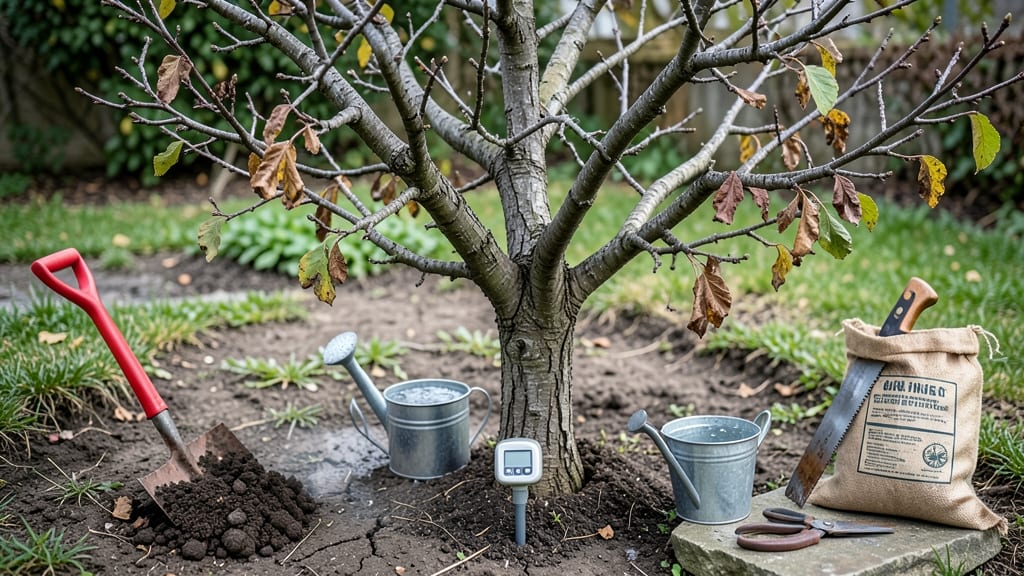
You can bring a dead tree back to life in some cases if it's dormant or suffering from treatable conditions, but irreversible biological death (no bark, no leaves, no green tissue) means revival is impossible. Quick action with proper watering, pruning, and soil care is critical if the tree still shows signs of life like buds or green beneath the bark.
Revival depends on how "dead" the tree truly is. 🌱 Trees often appear lifeless during extreme drought or winter but can recover once conditions improve—look for green tissue under the bark or dormant buds as hopeful signs.
If the tree has lost all bark or shows no signs of internal moisture, biological death has likely occurred, making revival impossible. My approach starts with assessing the root system and soil health, as even the hardiest trees can't recover without proper hydration and nutrient support.
For trees with potential, I recommend a three-step process: deep watering to revive roots, pruning dead branches to redirect energy, and soil amendments like compost or mycorrhizal fungi to boost microbial activity.
Species like oaks or maples often respond well to these methods, while others may require more aggressive interventions like root aeration or targeted fertilizers.
💡 In This Article
- Signs a Tree Can Still Be Saved
- Step-by-Step Tree Revival Techniques
Signs a tree can still be saved
First, check the bark for any green tissue beneath the surface—this indicates the cambium layer, a living vascular layer essential for growth.
Even if the bark appears cracked or peeling, scrape a small section to reveal if the underlying tissue is moist and green. 🌿 Healthy cambium suggests the tree is dormant rather than truly dead, as this layer is the first to die when a tree reaches biological death.
For example, a maple tree with green cambium beneath split bark can often recover with proper care, while a completely blackened trunk signals irreversible damage.
The presence of buds is another critical indicator. Dormant buds appear as small, swollen nodes along branches, often covered in a protective layer.
If you find even one viable bud, the tree may still have the capacity to regrow once conditions improve. 🌱 Test this by gently scraping the bud—if it's firm and green underneath, it's a positive sign.
Compare this to a completely dry, brittle bud, which confirms the tree has lost its ability to regenerate. Season matters too: buds in late winter or early spring are more likely to be viable than those in peak summer drought.
Root health is harder to assess but can be inferred from soil conditions and branch vitality. Healthy roots maintain moisture and nutrients, which keeps branches flexible rather than brittle. 🌳 To test, gently bend a small branch—if it snaps cleanly with no bend, the tree is likely dead.
However, if it bends slightly before breaking, roots may still be alive. For a more accurate assessment, use a soil probe to check moisture levels at 12-18 inches deep; dry soil at this depth often correlates with root death, while damp soil suggests potential for revival.
Seasonal stress can mimic death, so timing is everything. A tree may appear lifeless during extreme cold or drought but can recover once conditions normalize. 🌡️ For instance, a live oak in winter may lose all leaves and appear dead, but its roots remain active.
Conversely, a tree with no leaves in summer heat might be truly dead if it's been without foliage for over a year. Always consider the tree's natural cycle—evergreens should never be completely bare, while deciduous trees naturally shed leaves seasonally.
Watch for sap flow as another definitive sign. If you cut a small section of bark and observe sap oozing, the tree is alive. 💧 This sap contains nutrients and water transported through the phloem, proving the tree's vascular system is still functional.
Lack of sap confirms biological death. For example, a birch tree with visible sap flow after pruning has a strong chance of recovery, while one with no sap response is beyond saving.
Finally, consider the tree's species.
Some, like willows or poplars, are highly resilient and may recover from severe stress, while others, like fruit trees, are more sensitive. 🌳 Research your tree's typical lifespan and stress tolerance—an old oak may be naturally declining, while a young apple tree should never appear completely dead unless diseased.
This context helps differentiate between natural aging and treatable conditions.