
Pruning
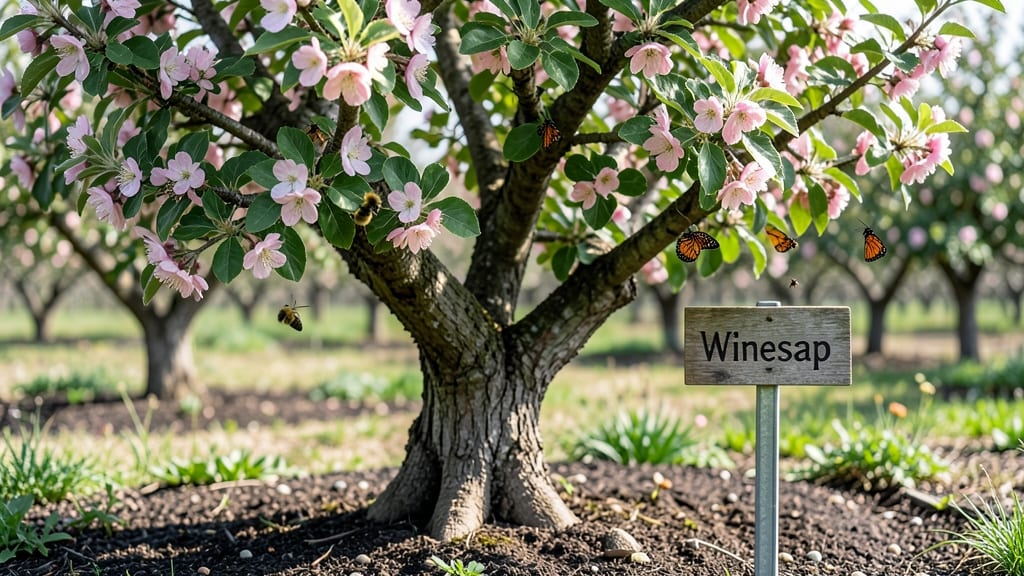
Winesap apple trees need compatible pollinators like Honeycrisp, Fuji, or Golden Delicious to bear fruit, since they're not self-pollinating. Planting a second variety within 50 feet maximizes pollination success and fruit production.
This isn't just about having another apple tree nearby—it's about timing and compatibility. Winesap blooms align best with varieties that flower within 2-3 days of its late-May to early-June bloom window. 🌸 For example, Honeycrisp's overlapping bloom period makes it one of the most reliable partners.
The 50-foot rule accounts for bee flight range, but wind-pollinated varieties can sometimes work up to 100 feet away, though yields may be lower.
What's fascinating is how bees actually do the heavy lifting—over 90% of apple pollination happens through insect activity. Planting native flowers like clover or bee balm near your orchard creates a pollinator highway, while avoiding neonicotinoid pesticides keeps these tiny workers thriving.
I've seen fruit set increase by 30% just by adding a few bee-friendly plants to the orchard perimeter.
💡 In This Article
- Best Pollinator Varieties for Winesap Apple Trees
- How to Attract Natural Pollinators to Your Apple Orchard
Best pollinator varieties for Winesap apple trees
The Winesap apple tree's inability to self-pollinate stems from its genetic makeup—it carries both male and female flower parts, but they're physically separated in a way that prevents effective self-fertilization.
This means pollen from a Winesap tree's flowers rarely reaches its own ovules. 🌼 What makes varieties like Honeycrisp and Fuji such effective pollinators is their compatible genetic markers that allow cross-pollination to occur efficiently.
These varieties share similar bloom periods (typically within 2-3 days) and produce pollen that's biologically compatible with Winesap's stigma.
Bloom timing is critical—Winesap trees typically flower in late May to early June, and the best pollinators align closely with this window. For example, Honeycrisp blooms just 1-2 days after Winesap, while Fuji's bloom period overlaps by 3-4 days.
Gala, another excellent partner, blooms slightly earlier (about 5 days before Winesap), but its pollen remains viable long enough to ensure successful cross-pollination. 🌸 Regional climate variations can shift these timings by up to a week, so local extension services often provide bloom compatibility charts tailored to your growing zone.
What's fascinating is how pollen viability plays into this equation. Winesap pollen remains active for about 3-5 days after the flower opens, while Honeycrisp's pollen stays viable for up to 7 days. This extended window means even slight timing mismatches can still result in successful pollination.
The 50-foot rule accounts for the average bee's flight range, but wind can carry pollen up to 100 feet—though yields typically drop by 20-30% beyond 75 feet due to reduced pollen density.
Color-coded bloom charts often show these relationships visually, with Winesap marked as a "Group 4" bloomer (using the National Apple Improvement Board's system).
This means it pairs best with other Group 4 varieties like Cortland or McIntosh, but also works well with Group 3 (like Gala) or Group 5 (like Fuji) due to their overlapping bloom periods.
The key is planting at least two compatible varieties within that 50-foot radius to ensure bees have multiple pollen sources during their foraging trips.
One common misconception is that any apple tree will work as a pollinator. In reality, some varieties like Granny Smith (which blooms much earlier) or Arkansas Black (which blooms later) won't effectively pollinate Winesap because their bloom periods don't overlap.
The 10% rule applies here—pollinators should share at least 10% genetic compatibility to ensure reliable fruit set. 🍏 This is why nurseries often recommend specific pairings based on your region's climate patterns.
For home orchards, consider planting a "pollination trio" combining Winesap with two compatible varieties. A classic combination might be Winesap (Group 4), Honeycrisp (Group 4), and Fuji (Group 5). This creates redundancy in case one variety has poor bloom alignment in a particular year due to weather variations.
The result? More consistent fruit production and apples that inherit desirable traits from both parent varieties.