
Trees
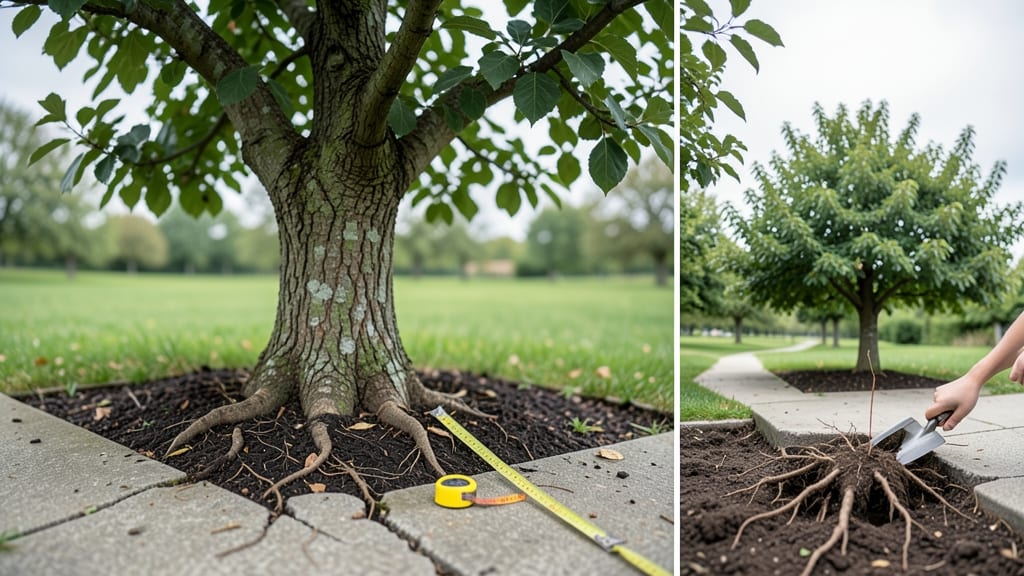
Apple tree roots do cause damage by spreading aggressively up to 30-50 feet wide and 6-8 feet deep, potentially lifting sidewalks, cracking foundations, or outcompeting nearby plants for moisture and nutrients. Even dwarf varieties develop expansive root systems that require strategic planting.
Apple tree roots grow aggressively to seek water and nutrients, especially in dry conditions. 🌳 The lateral roots spread horizontally while deep taproots extend downward, creating a vast network that can disrupt hardscapes and foundations.
Even dwarf varieties—though more compact—can still cause issues if planted too close to structures. The key is proper spacing and monitoring, particularly in urban or landscaped areas where root competition is most problematic.
This invasive growth isn't just about space—roots also release chemicals that suppress nearby plant growth, making them particularly troublesome in gardens. Understanding your soil type and tree variety helps predict potential damage, but proactive measures like root barriers or soil aeration can mitigate risks effectively.
💡 In This Article
- How Apple Tree Roots Spread and Their Growth Patterns
- Preventing Apple Tree Root Damage to Structures and Landscapes
How apple tree roots spread and their growth patterns
Apple tree roots grow in two primary ways: laterally (horizontally) and vertically (downward). The lateral roots spread outward from the trunk, creating a vast network that can extend 30-50 feet in ideal conditions, while the taproot system extends 6-8 feet deep to access groundwater.
This expansion is driven by the tree's need to compete for water and nutrients, especially in dry climates or poor soil.
The science behind this spread involves a process called hydraulic lift, where roots actively pull moisture from deep soil layers and redistribute it to surface roots. This behavior explains why apple trees often cause damage to sidewalks or foundations—even when planted 20+ feet away.
Soil type plays a critical role: clay soils restrict root growth, forcing them to spread wider, while sandy soils allow deeper penetration but with less lateral reach.
Seasonal growth cycles also affect root expansion. Apple trees experience two main growth phases: spring (when roots grow rapidly to access melting snowmelt) and late summer (when they expand to store nutrients).
Dwarf varieties, like Columnar or Spindle types, have more compact root systems but still spread 15-20 feet wide—about half the width of standard trees. Their roots grow shallower, making them less likely to crack foundations but more prone to lifting paving stones.
What most people don't realize is how roots adapt to obstacles. When they encounter barriers like foundations or compacted soil, they'll grow around or above them, sometimes even breaking through concrete if given enough time.
This is why urban planners recommend keeping apple trees at least 25 feet from buildings—even dwarf varieties can cause structural stress over decades.
Consider this comparison: A standard apple tree might have 50,000+ roots in its mature state, while a dwarf variety could have 10,000-20,000 roots.
The difference isn't just in size but in growth strategy—dwarf trees prioritize vertical growth first, then spread laterally, which is why they're often recommended for small properties. However, their roots still seek moisture aggressively, making them competitive with nearby plants.
For example, I've seen Honeycrisp apple trees in suburban yards lift concrete patios within 5-7 years of planting, despite being labeled as "dwarf." The key takeaway is that no apple tree—standard or dwarf—is truly "root-bound" in the traditional sense.
Their growth patterns are designed for survival, which means they'll always seek space, water, and nutrients, regardless of human expectations. 🌱