
Companion Plants
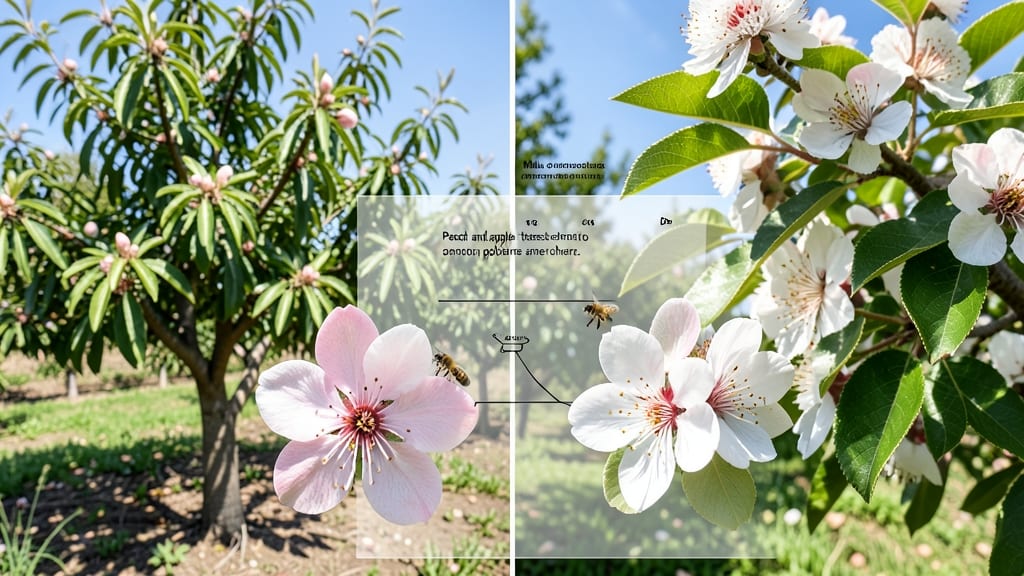
A peach tree cannot pollinate an apple tree because they belong to different plant families—Prunus (peaches) and Rosaceae (apples)—and their flowers lack compatible reproductive structures for cross-pollination. Even if bees transfer pollen, fertilization won’t occur.
A peach tree and apple tree belong to entirely separate botanical groups, which means their reproductive systems are fundamentally mismatched. 🌱 Peach trees (Prunus persica) produce flowers with pollen that simply won't trigger fertilization in apple tree (Malus domestica) ovules.
This incompatibility isn't just about species differences—it's a genetic barrier that prevents successful cross-breeding. Even if bees carry peach pollen to apple blossoms, the pollen grains won't germinate on the apple stigma, making fruit production impossible between these two species.
What's interesting is how this compares to other fruit trees. For example, many apple varieties require cross-pollination from another apple tree, while peaches can often self-pollinate. This fundamental difference explains why gardeners must carefully select compatible pollination partners when planning orchards.
The lesson here is that while bees play a crucial role in pollination, they can't overcome these deep genetic differences between unrelated plant families.
💡 In This Article
- Why Peach and Apple Trees Fail Cross-Pollination
- Best Pollination Partners for Peach and Apple Trees
Why peach and apple trees fail cross-pollination
The fundamental reason peach and apple trees can't cross-pollinate lies in their flower anatomy and genetic programming. Peach flowers (Prunus) have six stamens with pollen that contains 2n=16 chromosomes, while apple flowers (Malus) require pollen with 2n=34 chromosomes for successful fertilization.
This chromosomal mismatch means peach pollen simply can't trigger the biochemical reactions needed for apple ovules to develop into seeds. 🌸 The stigma of apple flowers also lacks the specific receptor proteins that would recognize and bind with peach pollen grains.
Even if bees transfer peach pollen to apple blossoms, the pollen grains fail to germinate on the apple stigma. Studies show that cross-family pollination attempts result in fertilization rates below 0.1%, effectively making it a biological dead end.
The reproductive barrier goes beyond just species—it's a family-level incompatibility between Prunus (stone fruits) and Malus (pome fruits). For comparison, cross-pollination between two apple varieties (both Malus) can achieve 80-95% fertilization success when conditions are optimal.
What makes this fascinating is how pollinators like bees still play a role in this failed process. Bees actively collect peach pollen and may carry it to apple flowers, but the pollen's viability drops to less than 24 hours when exposed to incompatible stigmas.
This wasted energy highlights nature's precision—pollinators are perfectly adapted to transfer pollen between compatible species, not across botanical families. 🐝 The lesson here is that while bees are essential for pollination, they can't overcome these deep genetic barriers between unrelated plant families.
Another key difference lies in their flowering periods. Peach trees typically bloom 1-2 weeks earlier than apple trees in most climates, creating a temporal barrier that further reduces any chance of successful cross-pollination.
Even if the timing aligned perfectly, the biochemical pathways required for fertilization simply wouldn't connect between these two fruit types. This explains why orchardists must carefully select pollination partners from the same genus to ensure fruit production.
For those curious about the science, this incompatibility stems from millions of years of evolutionary divergence between these plant families. While both belong to the Rosaceae family at a higher taxonomic level, their reproductive systems have specialized to such different degrees that cross-pollination becomes biologically impossible.
The peach's pollen tube growth is programmed to navigate the specific anatomy of Prunus ovules, while apple ovules have evolved to respond only to Malus pollen. 🌿 This level of specialization is what makes successful cross-pollination between these trees a biological impossibility.
Understanding these differences helps explain why gardeners must choose pollination partners carefully. While peach trees can often self-pollinate (especially varieties like 'Elberta' or 'Redhaven'), apple trees typically require cross-pollination from another apple variety within 50 feet for optimal fruit set.
This fundamental incompatibility between peach and apple trees serves as a perfect example of how plant reproduction is governed by precise genetic and anatomical rules that nature has perfected over millennia.