
Plants
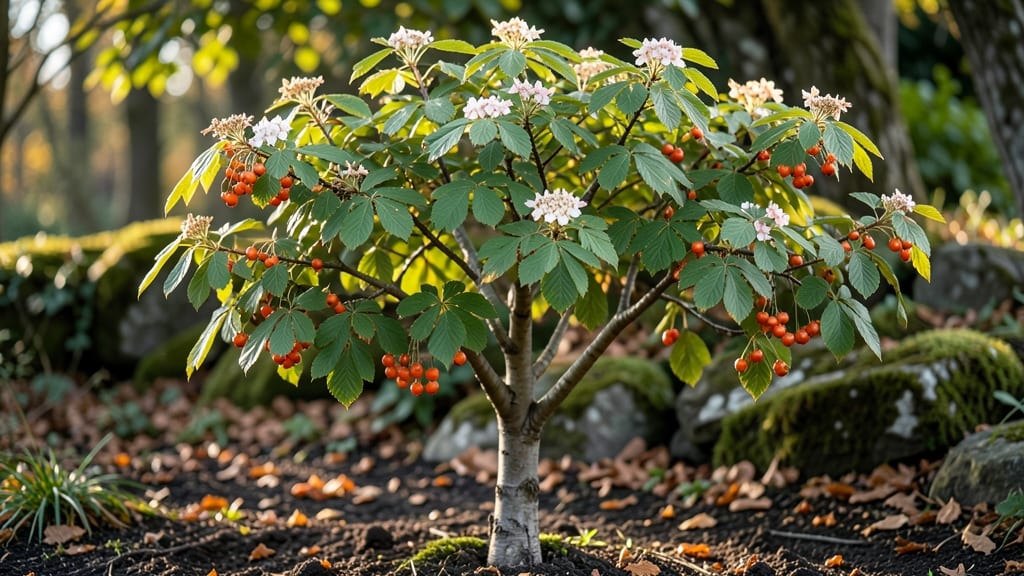
A rowan tree looks like a slender, upright tree with glossy green leaves that have serrated edges, delicate white to pink blossoms in spring, and striking clusters of bright red berries that remain through winter. Its bark starts smooth and gray but develops deep fissures as it ages, typically growing 15–25 feet tall.
A rowan tree's most eye-catching feature is its vibrant red berries, which stay on the branches even after the leaves fall—unlike many other trees. 🌿 These berries are often mistaken for mountain ash fruit, but rowan berries are smaller and grow in tighter clusters.
The leaves are another key identifier: they're elongated with finely toothed edges, creating a lacy appearance when backlit by sunlight. Younger trees have silky, smooth bark that gradually develops a rugged, diamond-patterned texture as they mature.
What sets rowan trees apart visually is their seasonal transformation. In spring, the tree bursts into bloom with delicate, five-petaled flowers that range from pure white to soft pink, creating a stunning contrast against the emerging foliage.
By summer, the leaves reach their full glossy green, while the berries begin to form—starting green before ripening to their signature bright red. This seasonal progression makes rowan trees a standout feature in any landscape.
💡 In This Article
- Identifying Rowan Tree Features by Season
- Visual Comparison: Rowan Tree vs Similar Trees
Identifying rowan tree features by season
The rowan tree's seasonal transformation is one of its most distinctive characteristics. In spring, it produces delicate clusters of five-petaled flowers that range from white to soft pink, measuring about 0.5 inches across.
These blossoms appear before the leaves fully emerge, creating a stunning contrast against the emerging green foliage. 🌸 The flowers are slightly fragrant, adding a subtle sweetness to the spring air, and they attract pollinators like bees and butterflies.
By summer, the tree's leaves reach their full maturity—glossy, bright green, and elongated with finely serrated edges. Each leaf typically measures 2-4 inches long and 1-2 inches wide, with a slightly pointed tip and a smooth, almost waxy texture.
The berries begin as small green orbs that gradually ripen to a vibrant red by late summer or early fall, forming dense clusters that can contain up to 50 berries per stem.
In fall, the rowan tree's berries reach their peak brilliance, turning a deep, glossy red that stands out against the changing autumn colors.
The leaves may develop subtle yellow or orange tinges before falling, but the berries remain attached to the branches, providing a striking contrast to the bare limbs.
This persistence is a key identifier—unlike many trees that drop their fruit in fall, rowan berries often stay until winter, sometimes even through early spring.
The tree's bark also evolves with the seasons and age. Young rowan trees have smooth, gray bark that feels almost silky to the touch. As the tree matures—typically after 10-15 years—the bark develops deep, diamond-shaped fissures that create a rugged, textured appearance.
These fissures become more pronounced with age, adding to the tree's winter charm. The bark's color may darken slightly in winter, taking on a muted gray-brown hue.
One of the rowan tree's most magical features is how its berries persist through winter, often covered in a light dusting of snow. These berries are not only visually striking but also play a crucial role in wildlife ecosystems, providing food for birds like thrushes and waxwings.
The tree's slender, upright growth habit—typically reaching 15-25 feet tall—gives it an elegant, almost fairy-tale-like appearance, especially when backlit by winter sunlight.
To truly appreciate a rowan tree, observe it across all four seasons. Each phase offers unique visual cues: the delicate spring blossoms, the glossy summer leaves, the vibrant fall berries, and the textured winter bark. This seasonal progression makes the rowan tree a year-round spectacle in any landscape. 🌲