
Trees
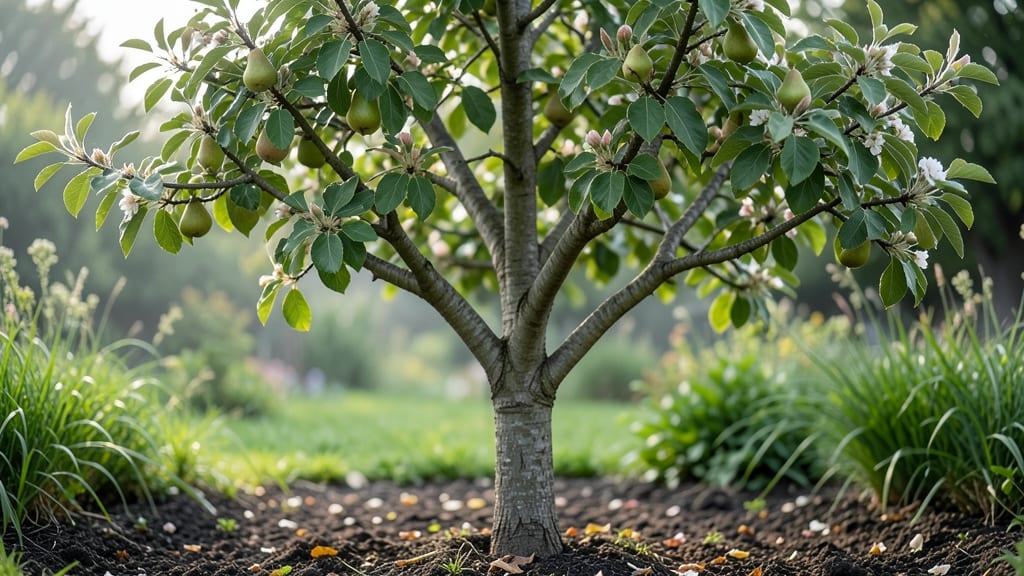
Pear tree leaves look like elongated ovals with pointed tips, jagged edges, and a shiny dark green top. They measure 2 to 4 inches long, grow alternately along branches, and feature fuzzy undersides with noticeable veins.
These leaves stand out because their serrated edges create a sawtooth pattern, while the fine hairs on the underside help distinguish them from similar trees like apple or cherry. 🌿 The glossy surface reflects light beautifully, making them easy to spot even from a distance.
What's fascinating is how the leaves change color in fall—turning vibrant yellow or orange before dropping, which helps identify mature pear trees in your yard.
If you're trying to identify a pear tree, focus on these three key features: the alternate leaf arrangement (unlike maple's opposite pattern), the pointed oval shape (wider at the base), and the hairy underside.
Many people confuse young pear trees with hawthorn or crabapple, but the leaf texture and vein prominence are dead giveaways.
Pro tip: Look for bud scales too—pear tree buds are plump and sticky, often covered in resin. This combination of leaf and bud traits makes pear trees one of the easiest fruit trees to identify accurately.
💡 In This Article
- Distinctive Traits of Pear Tree Leaves
- How to Identify Pear Trees in Your Garden
Distinctive traits of pear tree leaves
The leaves of a pear tree (Pyrus communis) have a unique combination of features that set them apart from other fruit trees.
Their shape is what first catches the eye—typically 2 to 4 inches long and 1 to 2 inches wide, forming an elongated oval with a distinctly pointed tip. This pointedness is more pronounced than in apple leaves, which tend to have a more rounded apex.
The edges are finely serrated, creating a delicate sawtooth pattern that's more regular than the coarser teeth of cherry leaves.
One of the most striking characteristics is the leaf's glossy dark green upper surface, which reflects light beautifully in sunlight. This glossiness comes from a waxy cuticle layer that helps reduce water loss—a survival adaptation for trees growing in temperate climates.
The underside, however, tells the real story: it's covered in fine, soft hairs that give it a velvety texture when you run your fingers across it.
These hairs are particularly noticeable when you hold a leaf up to the light, revealing a faint silver-gray fuzz that's absent in apple or cherry leaves.
The vein pattern is another key identifier. Pear leaves feature prominent midribs with secondary veins that branch out at 45-60 degree angles, creating a distinctive web-like pattern. These veins are more pronounced than in apple leaves, which have a smoother, less intricate network.
The contrast between the dark green upper surface and lighter underside creates a two-toned effect that's hard to miss when examining the tree from below.
What makes these leaves particularly useful for identification is their alternate arrangement along the branches. Unlike maple trees (which have opposite leaves) or dogwood (which has whorled leaves), pear tree leaves grow singly at each node, spaced evenly along the stem.
This arrangement, combined with the hairy undersides, helps distinguish young pear trees from lookalikes like hawthorn or crabapple, which often have smoother leaf surfaces.
The texture changes dramatically with the seasons. In spring, new leaves emerge a lighter green, almost yellowish, before maturing to their characteristic dark hue. As summer progresses, the leaves develop a slightly leathery feel, becoming more rigid.
By fall, they transform into vibrant yellows or oranges, often with red tinges near the edges—a color change that's more muted than the fiery reds of maple leaves but more intense than apple leaves.
Here's what happens under the microscope: those fine hairs on the underside are actually trichomes, tiny hair-like structures that serve multiple purposes. They help reduce water loss, reflect excess sunlight, and even deter some pests.
The serrated edges aren't just for show—they create microenvironments that can trap beneficial insects while making the leaves less appealing to certain herbivores.