
Container Gardens
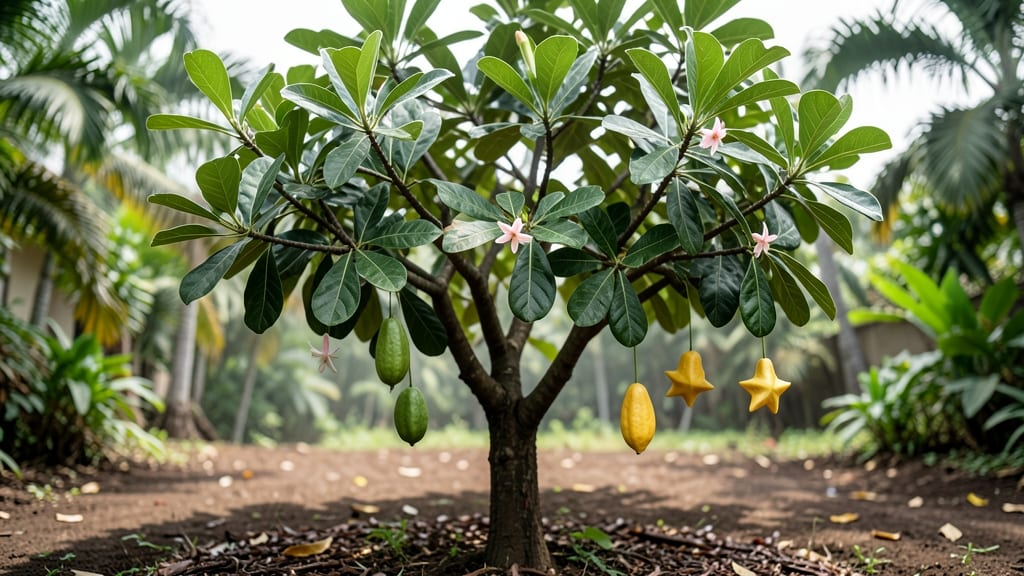
Star fruit trees grow best in USDA zones 10 through 12, where frost-free winters above 30°F protect their delicate tropical roots and fruit-bearing branches. These zones provide the ideal balance of warmth and humidity they need to thrive.
Star fruit trees are tropical plants that can't tolerate even light frost, which is why USDA zones 10-12 are their natural habitat. 🌿 The moment temperatures drop below 32°F, the tree's cells begin to rupture, leading to irreversible damage.
This is why gardeners in cooler climates often grow them in containers and bring them indoors during winter. The fruit itself also suffers from cold stress—exposure to chilly nights can cause blossom drop and poor fruit development, even if the tree survives.
What makes this tricky is that star fruit trees actually bloom and fruit only in warm conditions. If you're in zone 9 or cooler, you'll need to create a microclimate—like planting near a south-facing wall or using black plastic mulch to absorb heat.
For container growers, moving pots to a garage or sunroom during winter is a game-changer. The key is mimicking their native tropical environment as closely as possible.
💡 In This Article
- Why Star Fruit Trees Struggle Outside USDA Zones 10-12
- Extending Star Fruit Growth in Cooler Climates
Why star fruit trees struggle outside USDA zones 10-12
The core issue with star fruit trees (Averrhoa carambola) in cooler climates is their tropical biology. These trees evolved in Southeast Asia's humid, frost-free environments where temperatures rarely dip below 60°F year-round.
Their cells lack the protective mechanisms found in temperate plants, like the ability to produce antifreeze proteins or supercool their sap. When temperatures drop to 32°F, ice crystals form in their vascular system, rupturing cell walls and blocking water transport—similar to how a frozen pipe bursts.
Root systems are particularly vulnerable because they're shallow and spread wide to absorb surface moisture. Unlike hardy citrus trees that can survive brief cold snaps, star fruit roots begin dying at 30°F, and even brief exposure to 28°F can kill the entire plant.
The fruit itself also suffers from cold stress: blossoms drop when nights dip below 55°F, and developing fruits become misshapen or fail to ripen properly. This explains why you'll see star fruit trees in nurseries labeled as "tender"—they're essentially tropical plants with no cold tolerance.
Temperature fluctuations also trigger physiological stress. Star fruit trees require consistent warmth to maintain their metabolic processes, particularly for photosynthesis and fruit development. When nights cool below 65°F for extended periods, the tree enters a dormant-like state where growth slows dramatically.
This isn't true dormancy like apple trees experience—it's more of a survival mode that weakens the tree over time. The result? Reduced flowering, smaller fruit, and overall poor health. 🌡️
Another critical factor is humidity. Star fruit trees thrive in environments with 70-80% relative humidity, which helps prevent moisture loss through their leaves. In drier climates (common in zones 9 and above), even without frost, the tree struggles to maintain turgor pressure, leading to leaf drop and stunted growth.
This is why you'll often see star fruit trees in commercial groves grown near coastal areas where humidity remains high year-round.
What most gardeners don't realize is that even the fruit itself contains compounds that become unstable in cold conditions. Star fruit contains oxalates that can crystallize when exposed to temperature swings, which is why you'll sometimes hear about the fruit becoming "grainy" or developing off-flavors when grown in marginal climates.
The ideal growing conditions—consistent warmth, high humidity, and frost-free winters—are what allow the fruit to develop its signature crisp texture and sweet-tart flavor.
For those attempting to grow star fruit in cooler zones, understanding this biological sensitivity is crucial. The tree isn't just "picky"—it's fundamentally adapted to a narrow range of conditions that most temperate climates simply can't replicate without significant intervention.
This is why container growing and winter protection become essential strategies for success. 🌱