
Propagation
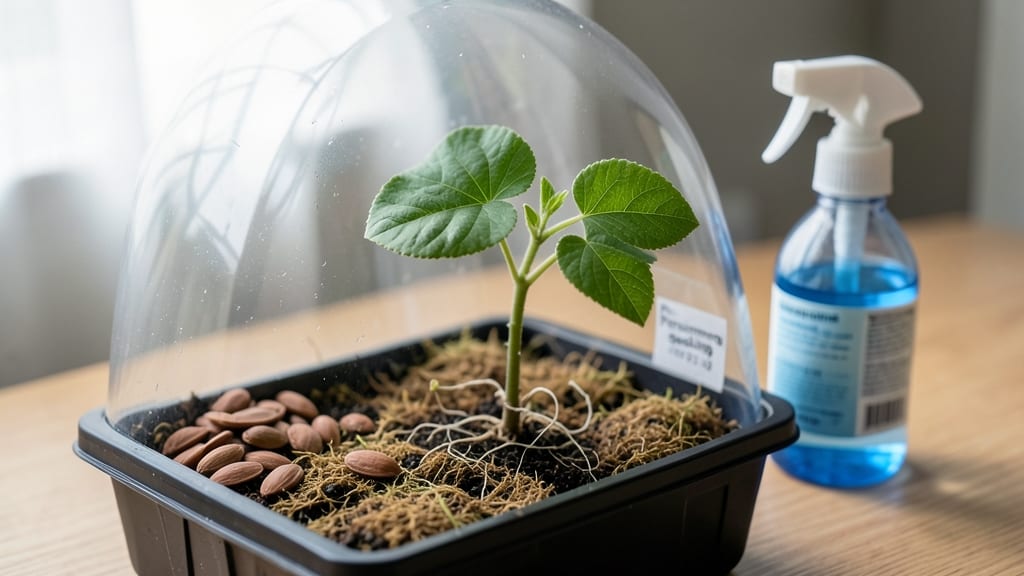
You can grow a persimmon tree from seed, but the resulting tree will likely produce fruit with unpredictable quality, size, or ripening characteristics compared to grafted varieties. Use only fully ripe seeds for the best 20-50% germination rate, and plan for a 2-3 year wait before potential fruiting.
Growing persimmons from seed is an experiment in genetic diversity—what you get depends entirely on the parent tree's traits. 🌱 The seeds you collect may grow into trees that bear fruit with completely different flavors, colors, or even ripening behaviors than the parent plant.
For example, a Fuyu persimmon seed might grow into a tree that produces astringent, wild-type fruit instead of the sweet, non-astringent variety you expected. This is why commercial growers use grafting instead of seeds: it guarantees consistent fruit quality from generation to generation.
If you're still eager to try seed propagation, start by extracting seeds from fully ripe fruit—this maximizes your chances of successful germination. The key step is cold stratification: after removing the pulp, plant the seeds in moist potting mix and refrigerate them for 60-90 days to break dormancy.
Once stratified, move them to a warm spot (around 70°F) and keep the soil consistently moist until sprouts appear, which can take anywhere from a few weeks to several months.
💡 In This Article
- Persimmon Seed Germination Science: Why Variety Matters
- Step-by-Step Guide to Growing Persimmons from Seed
Persimmon seed germination science: why variety matters
Persimmon seeds carry the full genetic blueprint of their parent tree, which is why seed-grown trees often produce fruit with wildly different traits. 🌱 The key difference lies in the plant's genetic makeup: commercial varieties like 'Fuyu' or 'Hachiya' have been selectively bred for non-astringent sweetness, uniform ripening, and specific fruit shapes.
When you grow from seed, you're essentially rolling the genetic dice—your tree might inherit traits from wild persimmon ancestors, including high tannin content (making the fruit astringent until fully ripe) or smaller, less flavorful fruit.
Seed dormancy is another critical factor affecting germination success. Persimmon seeds contain a hard outer shell that resists water absorption, combined with chemical inhibitors that prevent premature sprouting. This natural mechanism ensures seeds only germinate when conditions are optimal.
Cold stratification—mimicking winter's chilling period—breaks this dormancy by softening the seed coat and leaching out growth inhibitors. Research shows that 60-90 days of refrigeration at 34-40°F with consistent moisture yields the highest germination rates (20-50%), compared to just 10% without stratification.
The astringency gene (tan) plays a dramatic role in fruit quality. Cultivated varieties often have recessive alleles that suppress tannin production, while wild types express dominant alleles.
This means a seed from a sweet 'Fuyu' might grow into a tree producing astringent fruit—exactly why commercial growers graft desirable varieties onto rootstock. The genetic variability also affects tree size, cold hardiness, and disease resistance, making seed propagation more of a scientific experiment than a reliable propagation method.
Here's what happens biologically during germination: when properly stratified, the seed absorbs water and swells, breaking the seed coat. The radicle (root) emerges first, followed by the shoot. At this stage, the seedling relies entirely on its stored energy reserves—typically enough for 3-4 weeks of growth before it must photosynthesize.
During this time, maintaining 70-75°F soil temperatures and high humidity (70-80%) is crucial for survival, as cooler temperatures slow metabolic processes while excessive heat can cause rot.
Consider this comparison: grafted persimmon trees (like those in orchards) produce fruit identical to the parent plant within 2-3 years, with guaranteed quality. Seed-grown trees may take 5-7 years to fruit, and even then, the fruit could be completely different from what you expected.
For example, a seed from a 1-inch diameter 'Hachiya' fruit might grow into a tree bearing 3-inch fruit with orange flesh instead of the expected deep red. This genetic lottery is why seed propagation remains a hobbyist's pursuit rather than a commercial practice.