
Plants
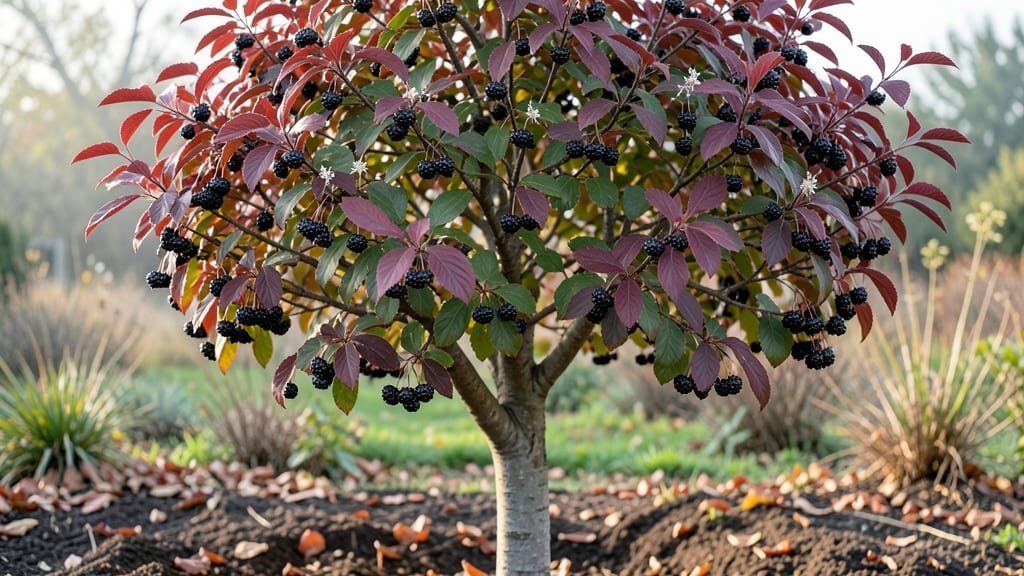
A chokeberry tree looks like a compact, multi-stemmed shrub or small tree, featuring glossy dark green oval leaves that dramatically shift to fiery red or deep purple hues in autumn. The tree's smooth gray bark and delicate springtime clusters of white flowers give way to glossy black berries later in the season, valued for both their health benefits and culinary potential.
A chokeberry tree's most striking feature is its leaves, which remain glossy and dark green throughout summer before putting on a spectacular fall show. 🌿 The leaves are oval-shaped with finely serrated edges, creating a dense canopy that makes the shrub easily recognizable.
This plant typically grows between 6 to 12 feet tall, with a spread of 6 to 10 feet, creating a perfect rounded shape that fits well in both formal gardens and natural landscapes.
The berries, which ripen in late summer, are small but packed with antioxidants, making them a favorite for jams, teas, and health-focused recipes.
The tree's bark is another distinguishing feature, remaining smooth and gray throughout its life, unlike many trees that develop rough textures as they age. In spring, the chokeberry produces clusters of small white flowers that add a delicate touch to the landscape before transforming into those glossy black berries.
This combination of features makes chokeberry trees particularly attractive to gardeners looking for both beauty and functionality in their outdoor spaces.
💡 In This Article
- Identifying Chokeberry Tree Leaves, Bark, and Branches
- Chokeberry Tree Growth Habits and Ideal Growing Conditions
Identifying chokeberry tree leaves, bark, and branches
The chokeberry tree's leaves are its most distinctive feature, with a glossy dark green color that resembles polished mahogany. Each leaf measures about 1.5 to 2.5 inches long and 1 to 1.5 inches wide, featuring smooth edges with fine serrations along the perimeter.
The upper surface is nearly waxy to the touch, while the underside has a slightly lighter hue and visible veins that create a delicate network pattern.
During fall, these leaves undergo a dramatic transformation, turning fiery shades of crimson, purple, or deep orange—a color shift caused by anthocyanin pigments that develop as chlorophyll breaks down.
The tree's bark remains smooth and gray throughout its life, unlike many shrubs that develop rough textures. Young branches are slender and reddish-brown, becoming more grayish as they mature.
What makes chokeberry branches unique is their tendency to arch slightly under the weight of the berries, creating a graceful, almost weeping appearance.
The berries themselves grow in dense clusters along these branches, each about 0.25 to 0.5 inches in diameter, with a glossy black surface that reflects light like polished obsidian. 🌟
One key way to distinguish chokeberry from similar shrubs like elderberry or dogwood is by examining the leaf arrangement. Chokeberry leaves grow alternately along the stems (one leaf per node), while elderberry leaves are opposite (two leaves per node).
Additionally, chokeberry flowers lack the prominent yellow centers found in elderberry blooms, and the berries remain attached to the tree much longer into winter, often persisting until spring. This extended berry retention is due to the fruit's high sugar content, which prevents early decomposition.
The chokeberry tree's growth habit creates a dense, rounded canopy that can reach 6 to 12 feet in height, with a spread of 6 to 10 feet. The branches form a multi-stemmed structure from the base, giving it a shrub-like appearance even when it grows taller.
This dense branching pattern provides excellent wildlife habitat, with birds frequently foraging on the berries. The tree's compact size makes it ideal for small gardens or hedgerows, where its seasonal color changes create year-round visual interest.
In terms of seasonal progression, spring brings clusters of small white flowers that lack petals but feature four sepals arranged in a cross-like pattern. These flowers give way to the glossy black berries by late summer, which remain on the tree until winter.
The berries' high tannin content makes them unpalatable raw but delicious when cooked, a trait that distinguishes them from other ornamental berries often used for decoration rather than consumption. 🍇
For gardeners looking to identify chokeberry trees, focus on these three visual cues: the glossy oval leaves with serrated edges, the smooth gray bark and reddish-brown young branches, and the dense clusters of glossy black berries that persist through winter.
These features create a unique visual signature that sets chokeberry apart from similar shrubs in both appearance and function.