
Pruning
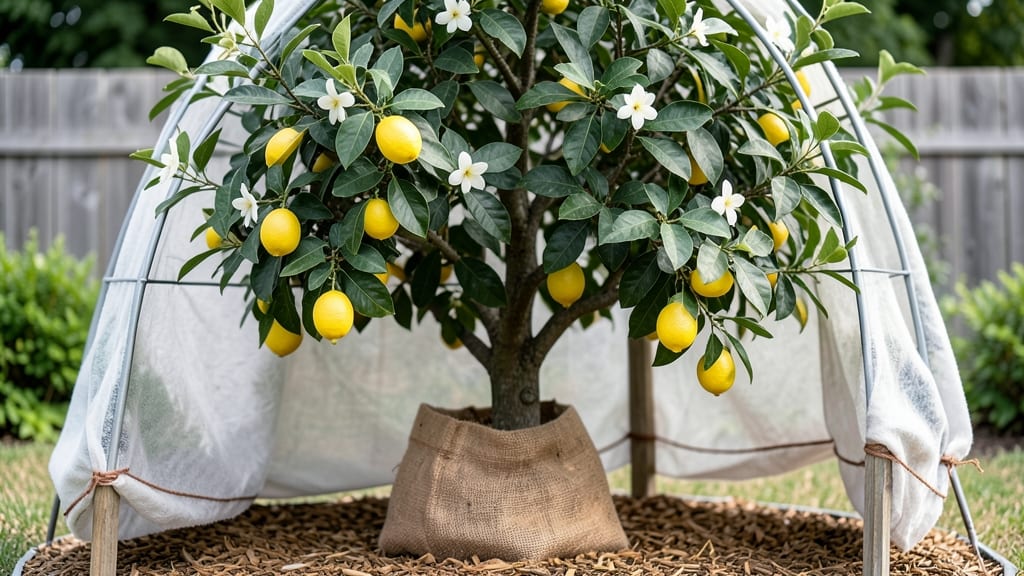
Whether you should cover your lemon tree in winter depends on your climate: in areas where temperatures drop below 20°F (-6°C), use frost cloth or burlap to protect the tree and roots, while milder regions only need light coverage for young or newly planted trees. Avoid plastic covers, as they trap moisture and can harm branches.
Deciding whether to cover your lemon tree comes down to understanding its cold sensitivity. 🍋 Lemon trees are tropical plants that typically thrive in USDA hardiness zones 9-11, meaning they can't handle prolonged exposure to freezing temperatures.
When frost hits, the water inside plant cells expands and ruptures, causing irreversible damage. Young trees are especially vulnerable because their root systems haven't fully developed to withstand winter stress. Even in milder climates, newly planted trees benefit from extra protection during their first few winters to establish stronger roots.
For areas with occasional light frosts, a simple frost cloth draped loosely over the tree works well. In colder regions, you'll need to create a more substantial barrier while ensuring good airflow to prevent rot.
The key is balancing protection with the tree's need to breathe—tight wraps can create moisture pockets that lead to fungal issues. I always recommend testing your local winter conditions first by monitoring overnight lows for at least a week before deciding on coverage.
💡 In This Article
- When and Why Lemon Trees Need Winter Protection
- Step-by-Step Guide to Safely Wrapping a Lemon Tree for Winter
When and why lemon trees need winter protection
Lemon trees are tropical plants that struggle when temperatures drop below 28°F (-2°C), where water inside their cells begins to freeze and expand. This cellular rupture causes irreversible damage to leaves, branches, and even the trunk.
The science behind this is simple: plant cells contain about 80-90% water, and when frozen, this water forms ice crystals that puncture cell walls. In lemon trees, this damage often appears as brown, mushy spots on leaves or cracked bark on young stems.
Root systems are particularly vulnerable because they're already stressed from limited water uptake in winter. Young trees, with their shallow root networks, are 3-5 times more sensitive to frost than mature specimens.
This is why newly planted lemon trees often need protection even in USDA Zone 9 areas, where mature trees might survive brief dips to 25°F (-4°C).
The root zone extends about 12-18 inches deep, so insulating this area with mulch (at least 3-4 inches thick) can make a dramatic difference in survival rates.
Your local climate plays the biggest role in determining protection needs. In Zones 9-10, where winters rarely drop below 20°F (-6°C), light frost cloth may suffice for young trees.
But in Zones 7-810°F (-12°C)—you'll need heavier protection like burlap wraps combined with root insulation. The key threshold is 28°F (-2°C)2-4 hours of exposure.
What most people overlook is how wind amplifies frost damage. Moving air creates a wind-chill effect, making 20°F (-6°C) feel like 10°F (-12°C) on exposed branches. This is why I always recommend securing covers with stakes or weights—even a loose wrap can be blown away, leaving critical areas unprotected.
The texture of frost cloth matters too: breathable fabrics like 50% polyester/50% cotton blends allow moisture to escape while blocking 80% of radiant heat loss.
Consider this real-world example: In Los Angeles (Zone 10), where winter lows rarely drop below 35°F (2°C), most lemon trees survive uncovered.
But in San Diego's coastal areas (also Zone 10), where offshore winds can create 15°F (-9°C) pockets, even mature trees benefit from light covers during cold snaps. This shows how microclimates create dramatic variation in protection needs—always check your specific location's frost history before deciding.
One final detail: Lemon trees enter dormancy in winter, but this doesn't mean they're frost-resistant. The dormancy period simply slows growth to conserve energy, but the cellular structure remains vulnerable.
Think of it like a tropical fish in a cold pond—it might slow down, but it won't survive freezing water. The same principle applies to your lemon tree's delicate physiology.