
Blooming
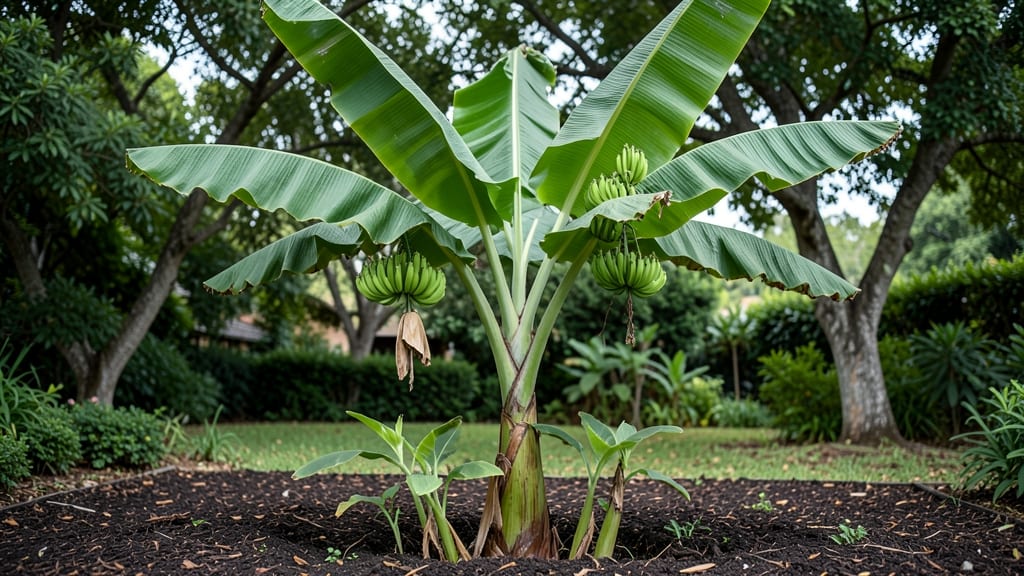
It takes a banana tree 9 to 12 months to produce fruit after planting, with dwarf varieties potentially fruiting in 6 to 9 months. Tropical varieties may take 12 to 18 months depending on growing conditions.
Banana trees follow a distinct growth cycle where timing depends heavily on their variety and environment. 🌱 The first 3 to 6 months focus on root and pseudostem development, while the final 3 to 6 months prepare for flowering—a critical phase that determines fruit production speed.
For example, Lady Finger bananas often fruit faster than Cavendish varieties because their growth habits are more compact and efficient. Proper care, including consistent moisture and well-draining soil, can shave weeks off the timeline by ensuring optimal nutrient uptake.
What many gardeners overlook is how temperature plays a role—banana trees thrive in 75-85°F conditions, and cooler climates can extend the fruiting window by 2-4 months.
Even in ideal settings, patience is key: the first harvest sets the stage for future cycles, with mature trees producing new bunches every 6-12 months thereafter.
💡 In This Article
- Banana Tree Growth Stages: From Planting to Fruit Production
- Fastest-Bearing Banana Varieties for Home Gardens
Banana tree growth stages: from planting to fruit production
Banana trees don't grow like typical trees—they develop through four distinct phases, each with precise biological triggers that dictate the timeline.
The first phase, called the vegetative stage, lasts 3 to 6 months as the plant focuses on building a strong root system and pseudostem (the thick, false trunk).
During this time, the tree absorbs 60-70% of its total nitrogen needs, which is critical for future fruit development. 🌱 The pseudostem isn't actually wood but layers of tightly packed leaf sheaths, growing at a rate of about 1-2 inches per week under optimal conditions.
Environmental factors dramatically influence this phase. Banana trees require consistent warmth (75-85°F) and 12+ hours of sunlight daily—any drop below 65°F can stall growth by 2-4 weeks. Soil pH between 5.5-7.0 ensures proper nutrient uptake, particularly potassium and phosphorus, which are vital for flowering.
For example, a tree planted in well-draining volcanic soil (common in Hawaii) may reach the next stage 30% faster than one in heavy clay because roots can expand more freely.
The second phase begins when the pseudostem reaches 10-15 feet tall, signaling the start of flowering. This transition is triggered by a combination of plant hormones (ethylene and gibberellins) and environmental cues like day length.
The flower bud, called a "heart," emerges from the center of the leaf sheaths and develops into a 1-2 foot long inflorescence over 4-6 weeks.
What's fascinating is that the first flowers at the base are male, while the fertile female flowers develop higher up—this ensures cross-pollination even without bees, as the wind carries pollen within the closed structure.
Once flowering begins, the fruiting phase takes 2-3 months to complete. The banana "hands" (clusters) develop from the top downward, with the youngest bananas at the base. Each hand contains 10-20 fingers, and the entire bunch can weigh 50-100 pounds by maturity.
The key factor here is water management—too much moisture causes the fruit to split, while drought stress reduces sugar content. 💧 In tropical climates, bananas ripen 2-3 weeks faster because higher humidity preserves their natural ethylene production, which softens the fruit and develops sweetness.
What most gardeners miss is how the root system's health directly impacts fruiting speed. A well-established root ball (spreading 3-5 feet deep) can absorb nutrients more efficiently, shaving 2-3 weeks off the timeline.
For instance, Dwarf Cavendish varieties, which are popular for home gardens, develop roots 20% faster than larger types because their compact growth habit encourages earlier flowering. This is why container-grown banana trees often fruit sooner—their roots are forced to branch densely in limited space, creating a more efficient nutrient network.
After the first harvest, mature banana trees enter a reproductive cycle where they produce new bunches every 6-12 months. The original pseudostem dies after fruiting, but the plant sends up 1-3 new shoots from the base, each capable of bearing fruit.
This means with proper care, a single banana tree can yield 2-3 harvests per year in tropical climates—though in cooler regions, the cycle may stretch to 18 months between fruiting events.
Understanding these stages helps gardeners anticipate care needs, like fertilizing 3-4 months before flowering to ensure the tree has enough energy for fruit development.