
Pruning
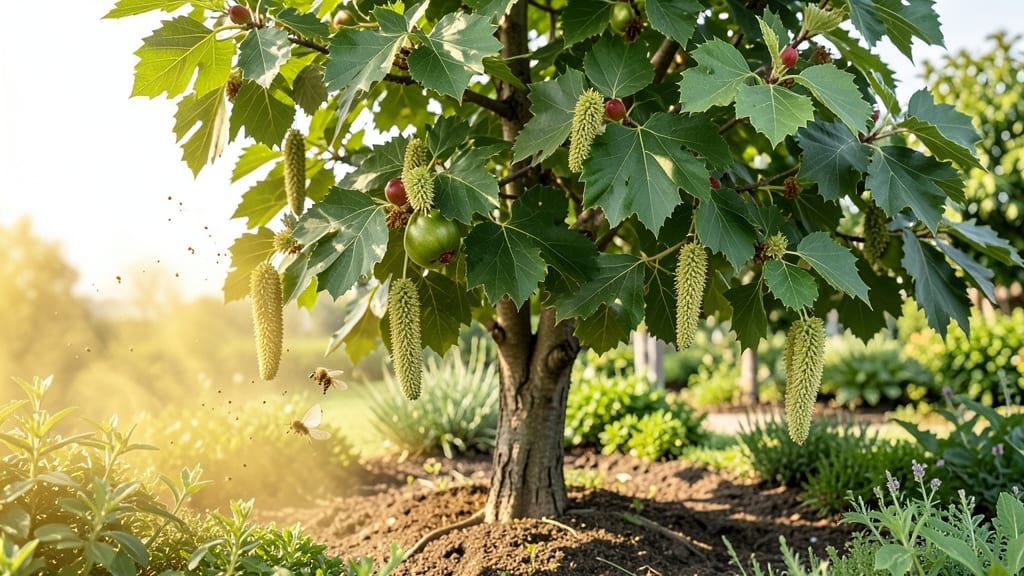
Mulberry tree pollination relies primarily on wind and insects, with male flowers producing pollen that must reach female flowers for fruit development. Bees and other pollinators enhance yield, while isolated trees may produce fewer berries due to limited cross-pollination opportunities.
Understanding how mulberry trees reproduce helps explain why fruit production varies so dramatically between trees. 🌿 These trees are dioecious, meaning separate male and female plants exist—male trees produce pollen-rich flowers while female trees develop berries.
Without proper pollination, female trees won't bear fruit at all. The good news? Strategic planting and pollinator support can dramatically boost your harvest by ensuring pollen transfer happens efficiently.
Wind plays a crucial role in spreading pollen, especially in open areas, but insects like bees and flies become the real game-changers. 🐝 A single hive can visit hundreds of flowers daily, creating a network that maximizes pollination.
That's why isolated trees often struggle—they simply don't get enough pollen visitors. The key to success lies in creating a pollinator-friendly environment while ensuring you have both male and female trees within close proximity.
💡 In This Article
- How Mulberry Trees Reproduce Through Wind and Insect Pollination
- Maximizing Mulberry Fruit Yield Through Strategic Pollination Practices
How mulberry trees reproduce through wind and insect pollination
Mulberry trees exhibit a fascinating reproductive strategy as dioecious plants, meaning male and female flowers grow on separate trees. The male flowers produce abundant pollen in catkin-like clusters that release their fine, powdery grains during early spring when humidity hovers around 60-70%.
These pollen particles, measuring just 20-30 microns in diameter, become airborne and travel up to 100 feet via wind currents—a process called anemophily. However, this method becomes less efficient in dense forests or urban areas where wind patterns get disrupted by buildings or foliage.
The real pollination magic happens when insects join the equation. Bees, particularly honeybees and bumblebees, are the superstars of mulberry pollination because they're attracted to the tree's sweet nectar and yellow-green flower clusters.
A single bee can carry 1-2 million pollen grains on its body, transferring them efficiently between male and female flowers. 🐝 Flies and beetles also play supporting roles, especially in regions where bee populations are lower.
The most effective pollination occurs when male and female trees stand within 50 feet of each other—this proximity ensures bees can make quick, efficient visits without expending too much energy.
Temperature plays a crucial role in this process, with optimal pollination occurring between 65-75°F. Cooler mornings (55°F) delay pollen release, while temperatures above 85°F can cause pollen to degrade before transfer.
Humidity matters too—dry conditions (40% or below) make pollen grains too light to stick to flower stigmas, while excessive moisture (> 80%) can drown them. This is why mulberry trees in Mediterranean climates often produce better fruit than those in consistently damp regions.
Here's what happens at the cellular level: When pollen lands on a female flower's stigma, it germinates and grows a pollen tube down through the style to reach the ovary. This process takes about 24-48 hours and requires consistent moisture.
Once fertilization occurs, the ovary begins developing into the characteristic black or red mulberries we harvest. Without proper pollination, female flowers simply drop off without forming fruit—a phenomenon gardeners notice as "empty clusters" hanging from branches.
Interestingly, mulberry trees have evolved different flower structures for wind vs. insect pollination. Wind-pollinated flowers have longer stamens to expose pollen to air currents, while insect-pollinated flowers produce more nectar and have sticky stigmas to catch pollen.
This dual strategy explains why mulberry orchards often produce better yields than isolated trees—multiple pollination vectors create redundancy in the system. 🌿 The most productive scenarios combine both wind dispersal (for pollen spread) and insect activity (for targeted transfer).
One fascinating adaptation is how mulberry trees time their flowering. Male trees typically bloom 1-2 weeks before female trees in a phenomenon called protandry. This ensures pollen is available when female flowers are receptive, maximizing fertilization opportunities.
In regions with unpredictable weather, this timing can shift—sometimes by as much as 10 days—which explains why some gardeners report inconsistent fruit production from year to year.